
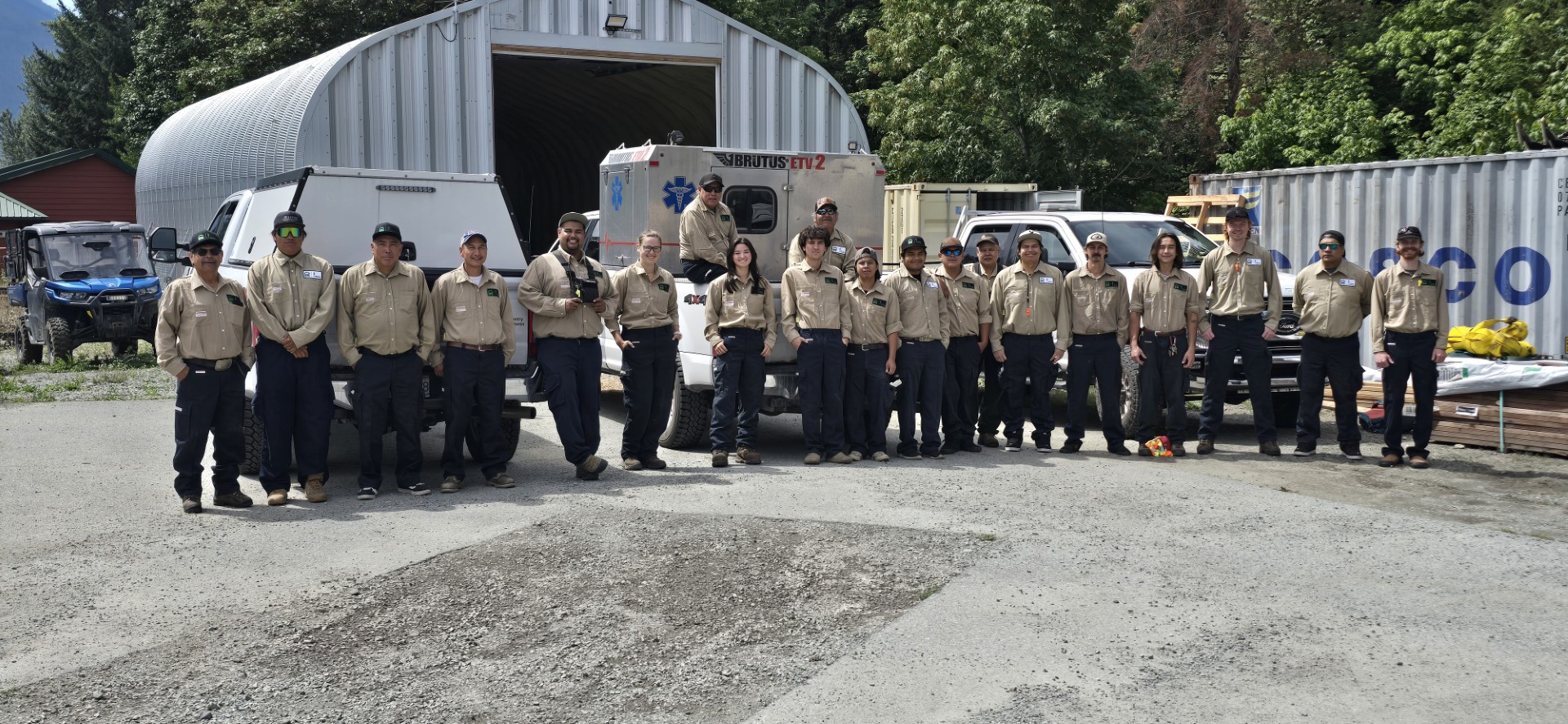
Lil’wat Forestry Ventures (LFV) had its first Firefighting contract crew 15 years ago. Starting with Type III Firefighting. Then 8 Years ago, LFV had its first Type II Firefighting contract and then two years ago we had our very first Indigenous Initial Response (IIR) Crew.
LFV has maintained a great relationship with BC Wildfire Service (BCWS), the Salish Unit Crew, and the Pemberton Fire Base for the past 15 years. Lil’wat Nation members have proudly served on the Salish Unit Crew, operating out of the Pemberton Fire Base for over 35 years.
Many of the LFV fire crew members work for LFV outside of fire season, primarily in the forest, assisting with silviculture projects, BC Hydro slashing projects (removing undergrowth and small tress directly under and around transmission lines and towers), local fuels management projects, as well as other contract work in the Sea to Sky region. As contract fire crews, all LFV crews are deployed upon request from BCWS.
Type 3 Firefighters
As an entry-level to wildland firefighting, type 3 firefighters play an essential role in supporting wildfire response efforts.
Prior to joining a crew, Type 3 firefighters must complete moderate physical test consisting of 3.2 kilometre walk within 30 minutes while carrying a 25-pound backpack, to ensure that they are up to the physical challenge of stepping into this role.
Type 3 crews are deployed to fires as support to BCWS, often as part of initial response to fires, either from home base, a fire base, or a fire camp. These crews operate in teams, ranging from 5, 10, or 20 members, and travel in trucks with one crew leader, two experienced firefighters, and a maximum of two inexperienced firefighters for a total of five members per truck. Each 5-man crew requires two drivers, a danger tree assessor, a chainsaw operator, and a first aid attendant (all LFV crew members have a minimum certification for Basic first aid with the Transportation endorsement). Deployments can reach a maximum of 14 workdays, including travel days. Workdays, also known as ‘Fire days’, are 12-hour days inclusive of travel to and from camp or hotel to the fire. Crews can expect to camp as a crew, or as part of a Fire Camp. Fire Camps provide restrooms, showers, hot food, bagged lunches, and security.
In the event of a fire, Type 3 firefighters primarily handle blacklining and mop-up (continual extinguishment of the fires edge and hot spots, worked from the outer edge to the centre of the fire), establishing trails and hose lays, digging fire guard, patrol duties (active searching for hot spots, flame and smoke), as well as demobilization (demob) activities such as rolling hose, and preparing pumps, hose, and other gear for transport back to BCWS facilities, typically after the fire is extinguished to 100%.