
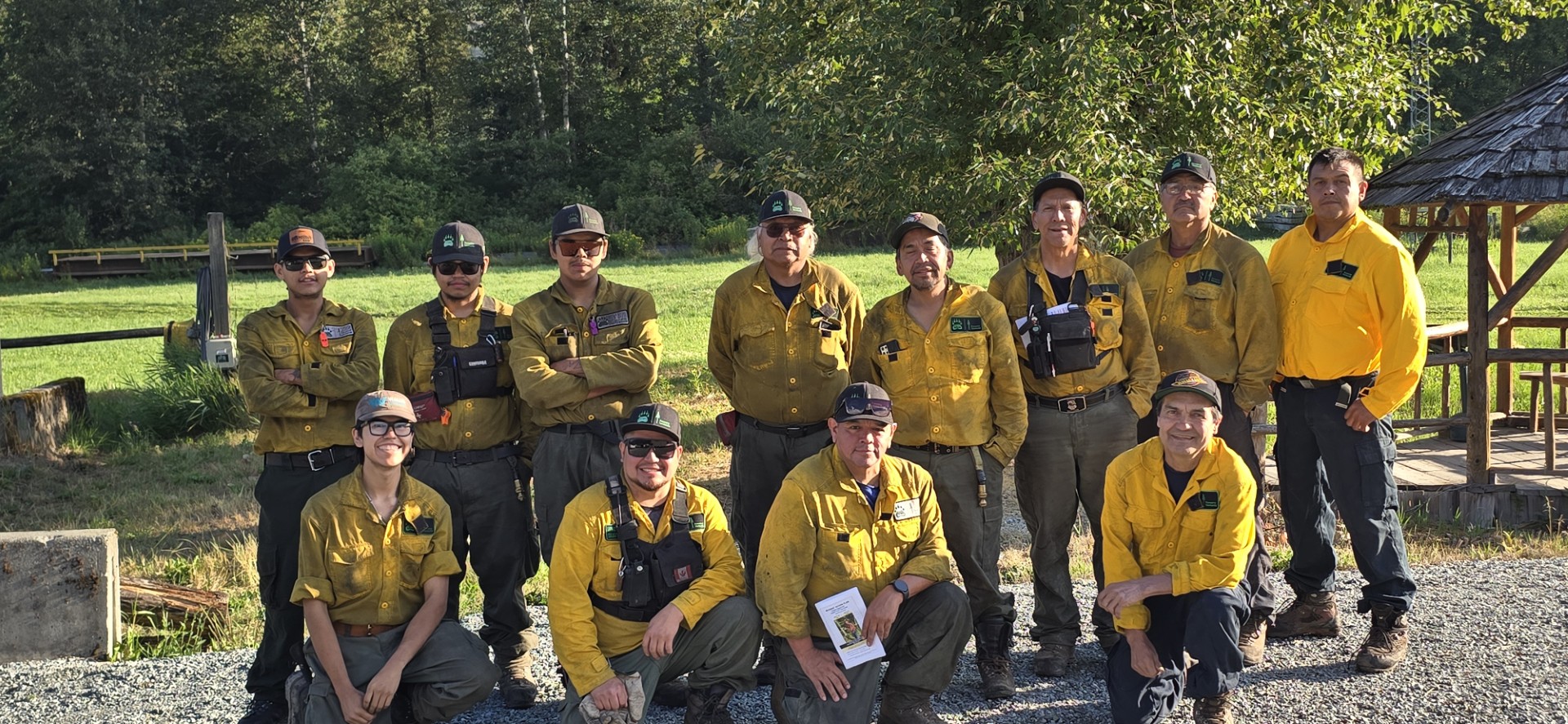
Lil’wat Forestry Ventures (LFV) had its first Firefighting contract crew 15 years ago. Starting with Type III Firefighting. Then 8 Years ago, LFV had its first Type II Firefighting contract and then two years ago we had our very first Indigenous Initial Response (IIR) Crew.
LFV has maintained a great relationship with BC Wildfire Service (BCWS), the Salish Unit Crew, and the Pemberton Fire Base for the past 15 years. Lil’wat Nation members have proudly served on the Salish Unit Crew, operating out of the Pemberton Fire Base for over 35 years.
Many of the LFV fire crew members work for LFV outside of fire season, primarily in the forest, assisting with silviculture projects, BC Hydro slashing projects (removing undergrowth and small tress directly under and around transmission lines and towers), local fuels management projects, as well as other contract work in the Sea to Sky region. As contract fire crews, all LFV crews are deployed upon request from BCWS.
Indigenous Initial Response
This crew is made up of four LFV firefighters employed by LFV and contracted by BCWS to respond to wildland fire incidents within the Líl̓wat, N’Quatqua, Tsal’alth, and Samahquam Territories, providing rapid initial response and support for BCWS while helping better protect the lands and communities they call home.
This crew responds from the LFV office in Mount Currie, utilizing a Ford F550 Initial Response truck. The IIR crew travels four per truck, including one crew leader, two experienced firefighters, and a maximum of one trainee. The IIR crew requires a chainsaw operator, a danger tree assessor, and an advanced first aid attendant are among the experienced firefighters. Currently, all IIR crew members must pass the same rigorous Wildland Fire Fighter Fitness test as the type 2 crews, which involves a challenging ramp circuit and a 65lb backpack, with a finish time of 17 minutes and 45 seconds or better.
IIR fire fighter tasks range from initial response to incidents, establishing trails and hose-lays, digging fire guard, mop-up, fire patrol, and demob (demobilisation) activities.
Unlike Type 2 and type 3 crews, the IIR crew operates on a schedule of workdays that spans from mid-July to mid-September, consisting of twelve 14-day shifts, with four 4-5 day breaks in between.