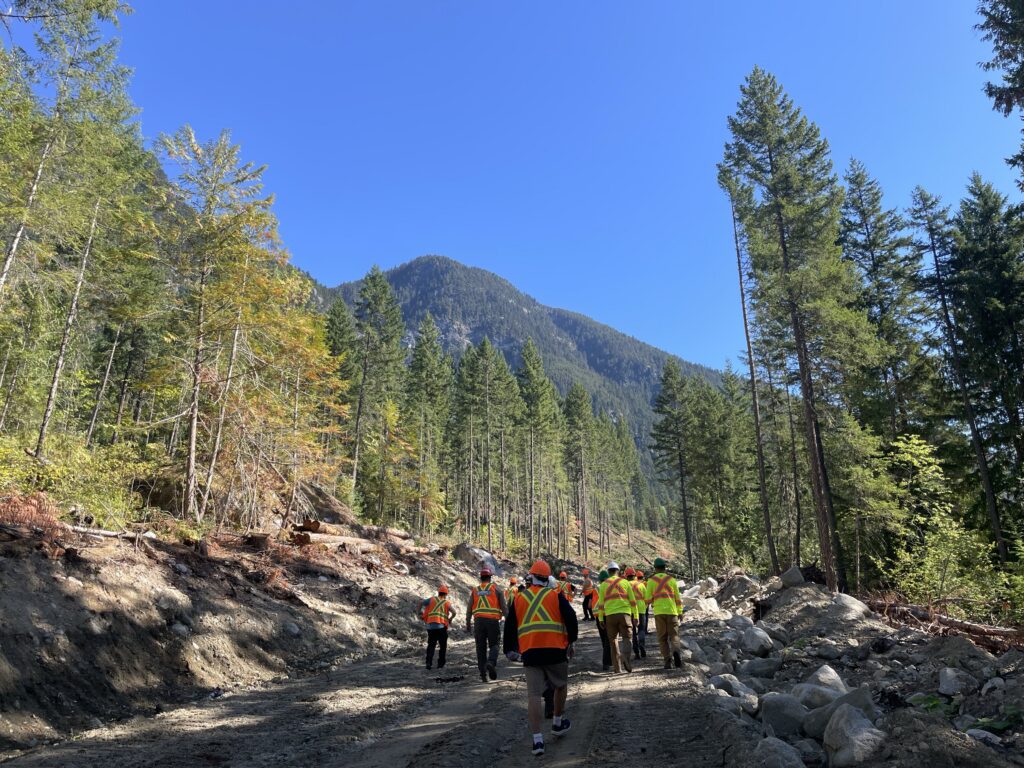
For Indigenous communities, caring for the land means balancing these interconnected values while creating opportunities for local people and strengthening community well-being. This understanding was at the center of a recent visit to Líl̓wat Territory, where Líl̓wat Forestry Ventures (LFV) welcomed participants from Université Laval’s Indigenous Forestry Exploratory Tour to learn more about Indigenous-led forestry and stewardship practices in British Columbia (B.C.).
Held from September 11 to 17, 2026, the tour brought together 27 participants, primarily from Quebec, including Indigenous community and business representatives, forestry professionals, researchers, students, and government and industry stakeholders.
Organized by Université Laval’s Leadership Chair in Indigenous Forestry Education and its partners, the tour explored different approaches to Indigenous forestry, forest governance, and land management across B.C.
As part of their journey, participants visited Líl̓wat Nation and the Osoyoos Indian Band, along with several forestry organizations project sites, to better understand how Indigenous communities are shaping forestry practices to reflect their own priorities, values, and relationships with the land.
For LFV, the visit was an opportunity to share how Indigenous knowledge, technical forestry expertise, and community priorities come together to guide forest management in Líl̓wat Territory.
Throughout their time with LFV, participants learned about the organization’s approach to forestry, which brings together wildfire risk reduction, ecological stewardship, cultural practices, and economic development.
Rather than viewing these as separate objectives, LFV’s work demonstrates how forest management can support multiple community priorities at once. Practices such as forest thinning, prescribed burning, and cultural burning can contribute to healthier, more resilient landscapes while supporting cultural connections to the land and creating opportunities for local employment.
For the visiting group, this integrated approach was one of the most meaningful takeaways.
“What stood out most was how closely Líl̓wat Forestry Ventures connects forest management with the priorities and well-being of the Líl̓wat Nation,” said Marie-Janick Robitaille, Research Professional at Université Laval. “We were particularly interested in how LFV integrates wildfire risk reduction, forest health, community safety, cultural practices, and economic development into its work.”
The visit also highlighted the importance of developing local skills and expertise. By providing training and employment opportunities in forestry, firefighting, and silviculture, LFV helps build community capacity while keeping valuable knowledge and experience within the Nation.
Beyond the technical aspects of forest management, participants gained a deeper appreciation for the relationships between the land, wildlife, waterways, and cultural values.
One particularly memorable moment came when the group observed salmon and a bear cub feeding nearby. For participants, the experience offered a tangible reminder of the interconnected ecosystems that forestry practices must consider, and the importance of caring for the land.
The visit also encouraged broader conversations about Indigenous leadership in forestry and the different approaches to forest governance across Canada. Throughout the tour, participants examined how arrangements such as First Nations Woodland Licences and Community Forests can provide Indigenous communities with greater influence over forest management decisions. These examples were especially relevant to participants from Quebec, where discussions about the future of forest governance and Indigenous participation continue to evolve.
For Robitaille, the experience reinforced that forest tenure is about more than access to resources. It can also influence how communities establish their own priorities, make decisions about their territories, and create opportunities that reflect their cultural, environmental, and economic goals.
The group was also interested in how Indigenous knowledge and cultural practices are incorporated into forestry operations, particularly through approaches to wildfire management.
Prescribed and cultural burning, forest thinning, and community-based wildfire risk reduction offered valuable examples of how forest management can support ecological resilience while respecting Indigenous relationships with the land.
These conversations provided participants with new perspectives to bring back to Quebec, while recognizing that forestry approaches must be adapted to the unique ecological, cultural, and governance contexts of each territory.
For LFV, hosting the visiting group was just as much about learning from others as it was about sharing the work taking place in Líl̓wat Territory.
“We wanted to share what we’re doing here in Líl̓wat Territory, but we also wanted to learn from them,” said Klay Tindall, General Manager of LFV. “That’s really what these field visits are about. We can share ideas, talk honestly about what’s working and what’s challenging, and hopefully keep learning from each other.”
For both LFV and the visiting participants, this connection created opportunities to share knowledge and explore different approaches to common challenges facing Indigenous communities and the forestry sector.
Robitaille emphasized that meaningful knowledge exchange is not simply about transferring practices from one region to another. It is about creating relationships built on mutual respect, trust, and recognition of Indigenous communities’ authority over their own knowledge and experiences.
“Although we travelled to B.C. primarily to learn, we see this as the beginning of a two-way relationship,” Robitaille shared.
Looking ahead, Université Laval representatives expressed interest in continuing the exchange, including opportunities for LFV representatives to share their experiences with audiences in Quebec and learn more about forestry initiatives led by First Nations in that province.
There is also potential to explore a broader community of practice connecting First Nations in Quebec and B.C., creating opportunities for ongoing conversations, professional relationships, and collaboration around Indigenous forestry and stewardship.
For LFV, these connections reflect the broader importance of Indigenous leadership in shaping the future of forestry. By sharing experiences, learning from different perspectives, and strengthening relationships, Indigenous forestry organizations can continue advancing approaches that reflect the priorities of their communities and the long-term health of their territories.
As Robitaille reflected, the lasting value of the tour lies in the opportunity to continue sharing knowledge and building relationships that support Indigenous-led forestry for generations to come.